Food is much more than something that simply fills our stomachs. Every meal we eat is made up of different nutrients that nourish the body, support growth, repair tissues, and regulate countless biological processes. Without these nutrients, the human body would struggle to perform even the most basic functions such as breathing, digesting food, maintaining body temperature, and producing energy. Nutrition scientists classify nutrients into different groups to better understand their functions, quantities, and roles in maintaining health.
Understanding the classification of nutrients is essential for students of nutrition, home economics, medicine, and health sciences. It also helps individuals make smarter dietary choices. Each nutrient category plays a unique role in supporting the body’s structure, metabolism, and overall wellbeing. Some nutrients supply energy, others build body tissues, while some regulate chemical reactions within cells.
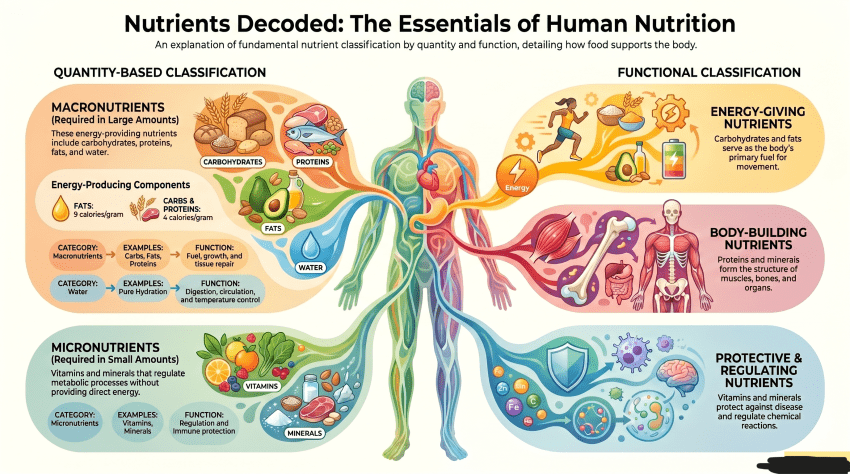
Researchers generally divide nutrients into several classifications based on quantity required, function, chemical nature, and essentiality. The most common classification separates nutrients into macronutrients and micronutrients, depending on how much the body requires. Macronutrients are needed in larger amounts and include carbohydrates, proteins, and fats, while micronutrients are required in smaller quantities and include vitamins and minerals.
This article explores the complete classification of nutrients, explaining each category in detail, including their functions, examples, sources, and importance for human health.
What Are Nutrients?
Nutrients are chemical substances found in food that the body requires for growth, energy production, repair of tissues, and regulation of body processes. In simple terms, nutrients are the building blocks that keep our bodies functioning properly. Every cell, organ, and system in the body depends on nutrients to survive and perform its tasks efficiently.
When we eat food, our digestive system breaks it down into smaller components that the body can absorb and utilize. These components include carbohydrates, proteins, fats, vitamins, minerals, and water. Each nutrient performs a specific role. For example, carbohydrates provide energy for daily activities, proteins help build muscles and tissues, while vitamins and minerals regulate chemical reactions and maintain immunity.
The concept of nutrients is closely linked to the science of nutrition, which studies how food affects health and disease prevention. Without adequate nutrient intake, the body may develop deficiencies that lead to serious health problems such as anemia, weakened immunity, poor growth, and chronic diseases. For instance, lack of iron can lead to anemia, while insufficient vitamin D may cause bone disorders.
Nutrition experts classify nutrients into several categories to simplify their study and understand how they contribute to health. The most widely accepted system groups nutrients into macronutrients and micronutrients, depending on the amount required by the body.
Understanding what nutrients are and how they work together helps people maintain a balanced diet and prevent nutritional deficiencies.
Importance of Nutrients in Human Health
The human body functions like a highly complex machine, and nutrients act as the fuel and maintenance system that keeps it running smoothly. Without adequate nutrients, even simple bodily functions would eventually slow down or fail completely. From the moment we wake up in the morning to the time we fall asleep at night, nutrients continuously support every movement, thought, and bodily process.
One of the most significant roles of nutrients is energy production. Carbohydrates, fats, and proteins provide calories that fuel physical activity, brain function, and metabolic processes. Without sufficient energy intake, the body begins to break down stored tissues, leading to fatigue, weakness, and reduced productivity.
Another essential role of nutrients is growth and repair. Proteins, minerals, and certain vitamins are required to build muscles, bones, skin, and internal organs. During childhood and adolescence, proper nutrition supports rapid growth and development. In adults, nutrients help repair damaged tissues and maintain body structure.
Nutrients also function as regulators of body processes. Vitamins and minerals participate in enzyme reactions, hormone production, immune responses, and nerve signaling. Even though these nutrients are required in smaller amounts, they play vital roles in maintaining health and preventing disease.
Water, often overlooked in nutrition discussions, is another crucial nutrient that supports digestion, circulation, temperature regulation, and waste removal. Without adequate hydration, the body cannot maintain its normal physiological balance.
Understanding the classification of nutrients allows health professionals, students, and individuals to identify the specific roles each nutrient plays in maintaining optimal health.
Major Classification of Nutrients
The most fundamental way to classify nutrients is by the quantity required by the body. Based on this criterion, nutrients are divided into two major categories: macronutrients and micronutrients. Macronutrients are required in large amounts and provide energy, while micronutrients are needed in smaller amounts but are essential for regulating body processes.
Macronutrients
Macronutrients are nutrients that the body requires in large quantities, typically measured in grams per day. These nutrients provide energy and support major physiological functions such as growth, metabolism, and tissue repair. The primary macronutrients include carbohydrates, proteins, fats, and sometimes water.
Macronutrients are considered the energy-producing components of food, supplying calories that fuel bodily activities. Carbohydrates and proteins provide about 4 calories per gram, while fats provide approximately 9 calories per gram, making them the most energy-dense nutrient.
Carbohydrates
Carbohydrates are often described as the primary energy source for the human body. They are broken down into glucose, which fuels the brain, muscles, and other organs. Foods such as rice, bread, fruits, vegetables, and cereals are rich sources of carbohydrates.
Carbohydrates are classified into two main types: simple carbohydrates and complex carbohydrates. Simple carbohydrates include sugars that are quickly digested and absorbed, while complex carbohydrates contain fiber and starch that release energy more slowly.
A diet containing adequate carbohydrates supports physical activity, brain performance, and metabolic health. However, excessive intake of refined sugars can lead to obesity, diabetes, and other metabolic disorders.
Proteins
Proteins are often referred to as body-building nutrients because they play a crucial role in forming and repairing tissues. They are made up of amino acids, which are the building blocks of muscles, skin, enzymes, hormones, and immune cells.
Protein-rich foods include meat, fish, eggs, dairy products, legumes, and nuts. Some proteins contain all essential amino acids and are known as complete proteins, while others lack certain amino acids and are called incomplete proteins.
Proteins are particularly important during periods of rapid growth, such as childhood, adolescence, pregnancy, and recovery from illness or injury.
Fats
Fats, also known as lipids, are another major macronutrient that provides energy and supports various body functions. They help in the absorption of fat-soluble vitamins (A, D, E, and K) and play an essential role in hormone production and cell membrane formation.
Although fats have often been viewed negatively in the past, modern nutrition science recognizes their importance when consumed in appropriate amounts. Healthy fats from sources such as nuts, seeds, fish, and olive oil can improve heart health and support brain function.
Water
Water is sometimes overlooked as a nutrient, but it is one of the most essential substances for life. It makes up about 60% of the human body and participates in nearly every biological process, including digestion, circulation, and temperature regulation.
Without adequate water intake, the body becomes dehydrated, leading to fatigue, headaches, and impaired cognitive function.
Micronutrients
Micronutrients are nutrients required in very small amounts, typically measured in milligrams or micrograms per day. Despite their small required quantities, they are vital for maintaining health and supporting metabolic processes.
Micronutrients do not provide energy directly, but they help the body utilize energy from macronutrients and maintain normal physiological functions. The two main categories of micronutrients are vitamins and minerals.
Vitamins
Vitamins are organic compounds that regulate metabolic reactions within the body. They act as coenzymes, helping enzymes carry out chemical reactions necessary for energy production, immune defense, and cell growth.
Vitamins are classified into two groups:
- Fat-soluble vitamins: A, D, E, K
- Water-soluble vitamins: B-complex and vitamin C
Each vitamin performs specific functions. For example, vitamin C supports immune health and wound healing, while vitamin D helps maintain strong bones.
Minerals
Minerals are inorganic elements that contribute to the structural and regulatory functions of the body. They are found in bones, teeth, blood, and body fluids.
Minerals are classified into two groups:
| Type | Examples | Function |
| Major minerals | Calcium, magnesium, potassium | Bone formation and nerve function |
| Trace minerals | Iron, zinc, iodine | Enzyme activity and oxygen transport |
Mineral deficiencies can lead to conditions such as anemia, thyroid disorders, and weakened bones.
Classification Based on Function
Another way to classify nutrients is according to their role in the body.
Energy Giving Nutrients
These nutrients provide the energy required for physical activity and metabolic functions. Carbohydrates and fats are the primary energy sources, while proteins can also supply energy when necessary.
Body Building Nutrients
Proteins and certain minerals are responsible for the growth and repair of body tissues. They support the formation of muscles, bones, and cells.
Protective Nutrients
Vitamins and minerals help protect the body from diseases and regulate immune responses.
Classification Based on Chemical Nature
Nutrients can also be classified based on their chemical composition.
Organic Nutrients
Organic nutrients contain carbon and include:
- Carbohydrates
- Proteins
- Fats
- Vitamins
These nutrients are produced by living organisms and play major roles in metabolism.
Inorganic Nutrients
Inorganic nutrients do not contain carbon and include:
- Minerals
- Water
These nutrients support structural and physiological functions in the body.
Classification Based on Essentiality
Another classification system divides nutrients into essential and non-essential nutrients.
Essential Nutrients
Essential nutrients are substances that the body cannot produce on its own and must obtain from food. Examples include essential amino acids, certain fatty acids, vitamins, and minerals.
Non-Essential Nutrients
Non-essential nutrients are those that the body can synthesize internally, although they may still be beneficial for health.
Balanced Diet and Nutrient Classification
A balanced diet includes all nutrient categories in appropriate proportions. When macronutrients and micronutrients are consumed in balanced amounts, the body can perform its functions efficiently and maintain good health.
For example, a healthy meal might include whole grains for carbohydrates, lean meat or legumes for protein, vegetables for vitamins and minerals, and healthy fats such as olive oil.
Importance of Understanding Nutrient Classification
Understanding nutrient classification is important for several reasons. It helps individuals design balanced diets, prevent deficiencies, and improve overall health. Nutritionists, healthcare professionals, and educators also rely on nutrient classification to develop dietary guidelines and health programs.
For students studying home economics, nutrition, or health sciences, this topic forms a fundamental concept in understanding how food supports human life.
Conclusion
The classification of nutrients provides a structured way to understand how different components of food contribute to human health. Nutrients are broadly divided into macronutrients and micronutrients based on the amount required by the body. Macronutrients such as carbohydrates, proteins, fats, and water provide energy and structural support, while micronutrients like vitamins and minerals regulate metabolic processes.
Additional classifications based on function, chemical nature, and essentiality help deepen our understanding of nutrition science. By recognizing the importance of each nutrient category, individuals can make better dietary choices and maintain a balanced lifestyle.
Ultimately, proper nutrition is not about focusing on a single nutrient but about ensuring the body receives the right combination of all essential nutrients for optimal health.
FAQs
1. What are nutrients?
Nutrients are chemical substances present in food that the body needs for energy, growth, repair, and regulation of body processes.
2. What are the main classifications of nutrients?
Nutrients are mainly classified into macronutrients and micronutrients based on the amount required by the body.
3. What are examples of macronutrients?
Examples of macronutrients include carbohydrates, proteins, fats, and water.
4. What are micronutrients?
Micronutrients are nutrients required in small quantities and include vitamins and minerals.
5. Why is nutrient classification important?
It helps people understand how different nutrients work together to maintain health, prevent disease, and support body functions.