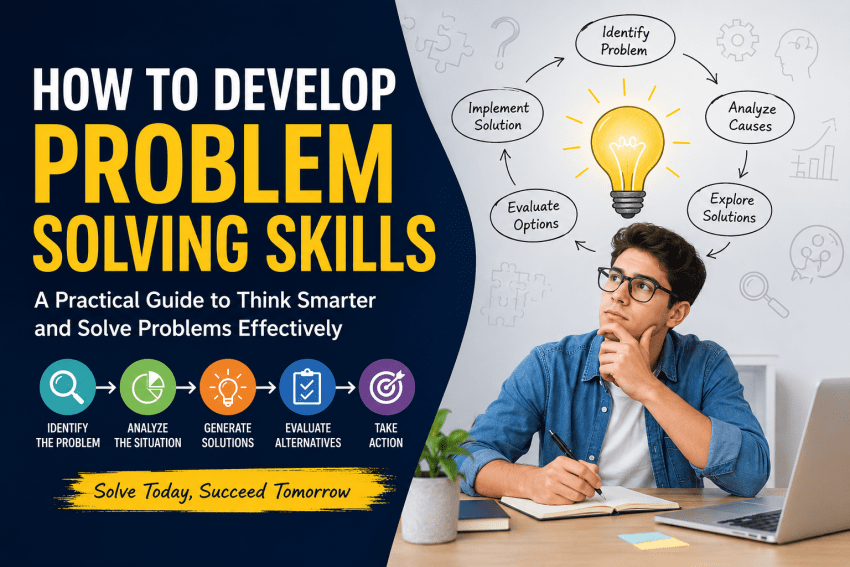
A Complete Guide to Thinking Smarter and Solving Problems Effectively
Modern employers consistently rank analytical thinking and problem-solving among the most important workplace skills. Research from the World Economic Forum shows that analytical, critical, and problem-solving thinking remain among the fastest-growing and most valuable skills for future jobs.
What Are Problem Solving Skills?
Problem-solving skills refer to the ability to identify challenges, analyze situations, evaluate alternatives, and implement effective solutions. These skills help people overcome obstacles in both personal and professional environments. Think about a doctor diagnosing an illness, a teacher handling classroom issues, or a business owner solving customer complaints. Each of these situations requires strong problem-solving skills.
Problem-solving is not simply about finding an answer. It involves understanding the root cause, collecting information, exploring different possibilities, and making informed decisions. Many people believe that problem-solving is a talent people are born with, but that is not true. Like learning to ride a bicycle or play a musical instrument, these skills improve through practice and experience.
In today’s rapidly changing world, the ability to solve problems has become more valuable than ever. Automation and artificial intelligence can perform repetitive tasks, but human judgment, creativity, and reasoning remain highly valuable. According to the World Economic Forum, analytical thinking and problem-solving continue to rank among the most important skills employers seek.
Why Problem-Solving Skills Matter Today
Imagine trying to navigate through a city without a map. Life becomes very similar when people lack problem-solving skills. Every day presents challenges, including financial decisions, workplace conflicts, academic difficulties, and personal relationships. People who solve problems effectively often experience greater confidence and better outcomes.
Modern workplaces especially value employees who can think independently. Companies want people who can identify problems before they become serious and suggest practical solutions. Research indicates that employers increasingly prioritize analytical thinking, creativity, and critical thinking skills because these abilities cannot easily be replaced by machines.
Students also benefit significantly from developing these skills. Academic success often depends on understanding concepts rather than memorizing facts. Problem solvers ask questions, investigate answers, and explore alternatives. This mindset promotes lifelong learning and adaptability.
Problem-solving additionally improves emotional intelligence. People become less reactive and more thoughtful when facing challenges. Instead of seeing obstacles as threats, they begin to view them as opportunities for growth and learning.
The Importance of Problem Solving in Daily Life
Problem-solving affects nearly every aspect of life. Consider a family budget that does not balance, a delayed project at work, or an unexpected medical issue. Each situation demands careful analysis and effective decision-making.
- In personal life, these skills help people manage time, finances, relationships, and responsibilities.
- Parents solve problems when raising children.
- Students solve problems while studying.
- Entrepreneurs solve problems when serving customers. Every successful outcome usually begins with identifying and understanding the issue.
Professional success also depends heavily on problem-solving abilities. Employers increasingly seek workers who can make decisions independently and contribute innovative ideas. According to recent workplace studies, critical thinking and problem-solving remain among the most valuable workplace competencies across industries. (SSRN)
People who develop these skills often become leaders because they can guide teams during difficult situations. Leadership frequently involves finding solutions rather than simply identifying problems.
Types of Problems People Face
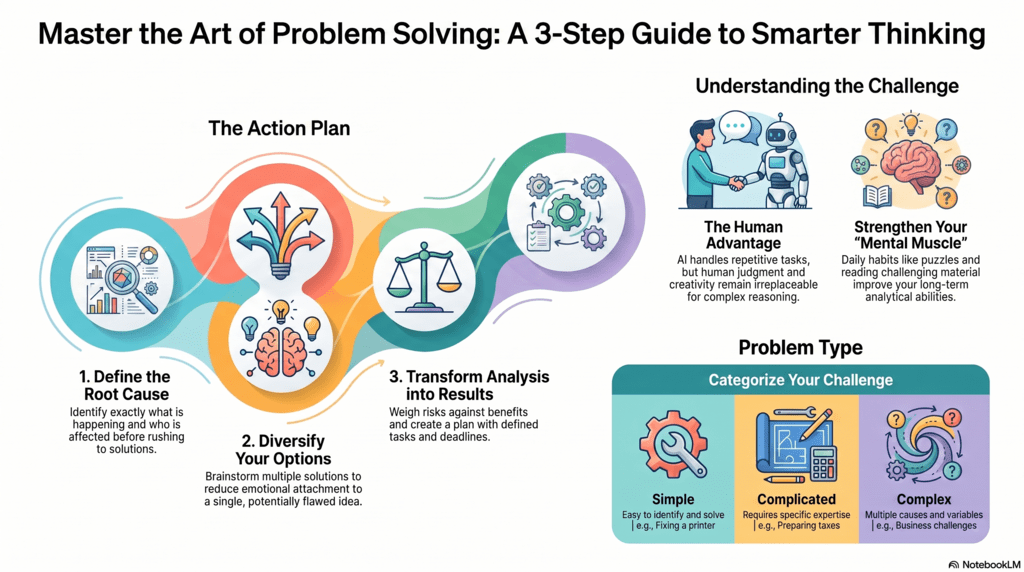
Not all problems are the same. Understanding different types of problems helps individuals choose the most appropriate solutions.
| Problem Type | Description | Example |
|---|---|---|
| Simple Problems | Easy to identify and solve | Fixing a printer |
| Complicated Problems | Require expertise | Preparing taxes |
| Complex Problems | Multiple causes and variables | Business challenges |
| Unexpected Problems | Sudden situations | Emergency decisions |
Simple problems often have clear solutions. Complex problems require investigation, collaboration, and experimentation. Many workplace challenges fall into the complex category because multiple factors contribute to the issue.
Learning to distinguish between these problem types allows people to use their time and resources effectively.
Essential Components of Problem Solving
Critical Thinking
Critical thinking involves examining facts objectively and avoiding assumptions. People ask questions such as:
- What is causing this issue?
- What evidence exists?
- Are there alternative explanations?
Creativity
Creativity allows individuals to explore unconventional solutions. Sometimes the obvious answer is not the best one. Creative thinkers combine ideas, experiment with alternatives, and challenge traditional approaches.
Decision Making
Decision-making transforms analysis into action. Without decisions, problem-solving remains incomplete. Effective decision makers weigh risks, evaluate consequences, and select the most practical option.
Emotional Intelligence
Emotions influence decisions. People who manage stress and emotions effectively often make better choices during difficult situations.
Step 1: Identify the Problem Clearly
Many people rush toward solutions without understanding the actual problem. Imagine treating symptoms without diagnosing the illness. The result may only provide temporary relief.
Start by asking:
- What exactly is happening?
- When did the problem begin?
- Who is affected?
- What are the consequences?
Writing the problem down often helps clarify thinking. A clearly defined problem is already halfway solved.
For example, a student saying, “I am failing mathematics,” may discover the real issue is poor time management or insufficient practice. Identifying the true cause prevents wasted effort.
Step 2: Gather Information
Good decisions require accurate information. Investigate the situation carefully before acting.
Consider:
- Facts and evidence.
- Previous experiences.
- Expert opinions.
- Available resources.
Information reduces uncertainty. Businesses frequently collect data before making strategic decisions because assumptions can lead to costly mistakes.
Asking questions is particularly valuable. Curious individuals often become excellent problem solvers because they continuously seek understanding.
Step 3: Generate Multiple Solutions
Strong problem solvers rarely stop at one answer. Instead, they brainstorm several possibilities.
Techniques include:
- Brainstorming.
- Mind mapping.
- Group discussions.
- Scenario planning.
Having multiple options increases the chances of success. It also reduces emotional attachment to a single solution.
Think of solutions as different roads leading to the same destination. One route may be faster, safer, or more economical than another.
Step 4: Evaluate the Alternatives
Every solution has advantages and disadvantages.
Ask yourself:
- What are the risks?
- What are the benefits?
- How much time will it require?
- What resources are needed?
| Solution | Cost | Risk | Effectiveness |
|---|---|---|---|
| Option A | Low | Medium | High |
| Option B | Medium | Low | Medium |
| Option C | High | High | Very High |
Evaluation helps prevent impulsive decisions. Successful organizations often use decision matrices because structured thinking improves outcomes.
Step 5: Take Action
Ideas alone do not solve problems. Action transforms plans into results.
Create a simple action plan:
- Define tasks.
- Set deadlines.
- Assign responsibilities.
- Monitor progress.
Many people struggle because they spend too much time planning and too little time implementing. Progress usually comes through action, feedback, and adjustment.
Even if a solution fails, valuable lessons emerge. Failure often provides information that improves future decisions.
Daily Habits That Improve Problem-Solving Skills
Developing problem-solving abilities requires consistent practice. Small habits can produce significant improvements over time.
Reading books exposes people to new perspectives. Puzzles and strategy games strengthen analytical thinking. Journaling helps organize thoughts and identify patterns. Discussions with others introduce alternative viewpoints.
Some effective daily habits include:
- Reading challenging material.
- Solving puzzles.
- Learning new skills.
- Asking questions.
- Reflecting on mistakes.
- Practicing decision-making.
Experts increasingly emphasize curiosity and lifelong learning as essential future skills. (arXiv)
The brain behaves much like a muscle. Regular exercise strengthens one’s ability to analyze, reason, and solve problems.
The Role of Technology and AI in Problem Solving
Artificial intelligence has changed the way people approach problems. AI tools can analyze data, generate ideas, and automate repetitive tasks. However, human judgment remains essential.
Experts increasingly argue that people must understand why a problem exists before using technology to solve it. AI works best when combined with human reasoning, creativity, and ethical judgment. (TechRadar)
Recent studies also suggest that excessive dependence on AI may reduce independent thinking skills if used improperly. Developing critical thinking alongside technology skills is therefore essential. (The Guardian)
The future belongs to individuals who can work alongside technology while maintaining strong analytical and problem-solving abilities.
Common Mistakes to Avoid
Many people unknowingly weaken their problem-solving abilities through poor habits.
Common mistakes include:
- Jumping to conclusions.
- Ignoring evidence.
- Avoiding feedback.
- Relying solely on emotions.
- Focusing on symptoms instead of causes.
- Refusing to consider alternatives.
Another major mistake is fearing failure. Every unsuccessful attempt provides information that improves future decisions. Thomas Edison reportedly viewed failed experiments as discovering ways that did not work.
Successful problem solvers remain flexible. They adjust strategies when new information becomes available.
Conclusion
Problem-solving is one of the most valuable skills anyone can develop. It improves academic performance, career opportunities, relationships, and personal confidence. The ability to identify problems, analyze situations, generate solutions, and make informed decisions creates long-term advantages in nearly every area of life.
Modern employers increasingly prioritize analytical, critical thinking, and problem-solving because these human abilities remain highly valuable in the age of artificial intelligence and automation. (World Economic Forum)
Developing these skills requires practice, curiosity, and persistence. Every challenge becomes an opportunity to learn, improve, and grow. The more problems you solve, the stronger your problem-solving abilities become.
FAQs
1. What is the best way to improve problem-solving skills?
Practice critical thinking, ask questions, analyze situations carefully, and solve real-life problems regularly.
2. Why are problem-solving skills important?
They help people make better decisions, overcome challenges, and succeed in both personal and professional life.
3. Can problem-solving skills be learned?
Yes. Problem-solving is a learnable skill that improves through practice and experience.
4. How long does it take to develop problem-solving skills?
Improvement depends on consistent practice, but noticeable progress can occur within a few months.
5. Are problem-solving skills important for future careers?
Yes. Employers increasingly value analytical thinking, creativity, and problem-solving abilities because these skills remain highly important in modern workplaces.