How to Get a Gun License in Pakistan
Owning a firearm in Pakistan is a legal right under specific conditions, but it is also a serious responsibility. Every firearm owner must comply with applicable federal and provincial laws, complete the required documentation, and pass verification before receiving a valid arms license. Regulations have evolved in recent years as provincial governments introduced computerized licensing systems and online application portals, making the process more transparent while strengthening security checks.
If you’re wondering how to get a gun license in Pakistan in 2026, this guide explains the latest eligibility requirements, required documents, application process, costs, renewal procedures, and important legal responsibilities.
Understanding Gun Laws in Pakistan
Pakistan regulates civilian firearm ownership through federal legislation as well as provincial rules. After constitutional changes that transferred several powers to the provinces, each province established its own licensing procedures while maintaining compliance with national firearms regulations.
Federal vs Provincial Arms Licenses
Federal and provincial authorities issue different categories of arms licenses depending on eligibility and jurisdiction. Provincial governments generally handle licenses for residents, while the federal government retains authority for specific categories and federal employees. Several provinces have computerized licensing systems integrated with NADRA records to improve verification and reduce fraud.
Types of Firearms
Pakistan generally distinguishes between:
| Category | Description |
|---|---|
| Non-Prohibited Bore (NPB) | Most civilian firearms permitted under applicable laws |
| Prohibited Bore (PB) | Restricted firearms subject to stricter federal control |
Availability depends on current government policy and eligibility requirements.
Who Can Apply for a Gun License?
Not every citizen automatically qualifies for a firearm license. Authorities carefully evaluate each application to ensure that applicants meet legal standards and public safety requirements.
Eligibility Requirements
Applicants generally need to:
- Be a Pakistani citizen.
- Hold a valid CNIC.
- Meet the minimum age requirement applicable in their province.
- Have no serious criminal record.
- Successfully complete verification and security checks.
- Provide required supporting documents.
For example, Punjab currently accepts eligible applicants aged 20 years or above, while age requirements may differ in other provinces.
Who May Be Disqualified?
Applications may be refused if an applicant:
- Has serious criminal convictions.
- Provides false information.
- Fails background verification.
- Cannot satisfy provincial eligibility criteria.
- Is prohibited by law from possessing firearms.
Approval always remains subject to government scrutiny and applicable regulations.
Documents Required
Although requirements vary slightly across provinces, applicants are commonly asked to submit several identity and supporting documents.
Personal Documents
Typical requirements include:
- Original CNIC and copies
- Passport-size photographs
- Completed application form
- Proof of residence where applicable
Supporting Certificates
Depending on your province or employment status, authorities may also require:
- Character certificate
- Medical certificate (where applicable)
- Departmental NOC for government employees
- Tax documentation or NTN in certain jurisdictions
- Affidavit or additional declarations
Islamabad’s published requirements include CNIC copies, photographs, proof of residence, NTN certificate, and departmental NOC for government servants.
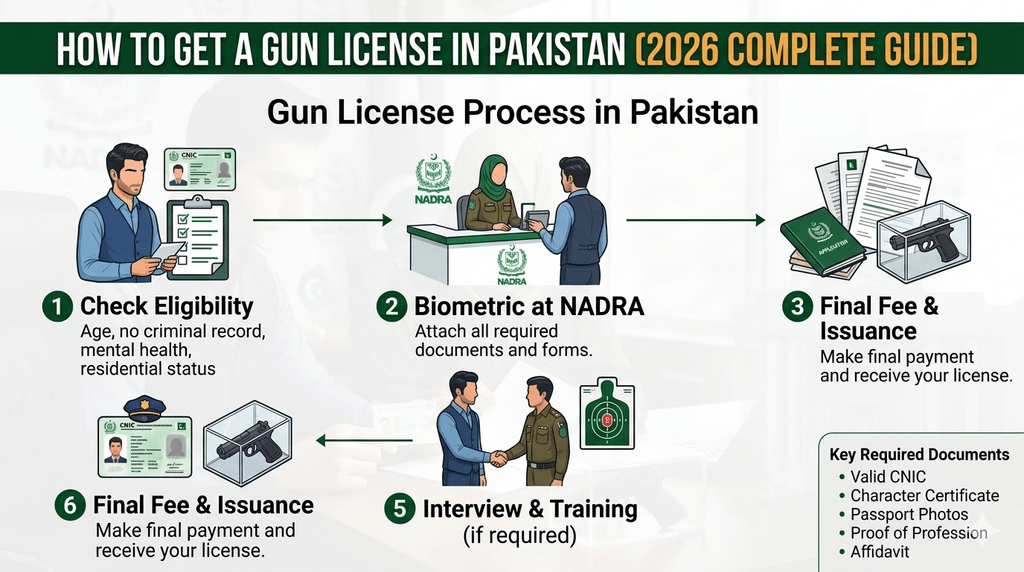
Step-by-Step Application Process
The licensing process has become increasingly digital in many provinces.
Step 1: Submit the Application
Eligible applicants submit the prescribed application through the designated provincial portal or authorized government office. Punjab, for example, introduced online applications for several categories of licenses.
Step 2: Identity Verification
Authorities verify:
- CNIC details
- Residential information
- Supporting documents
- Applicant identity through NADRA-linked records where applicable
Step 3: Background and Security Clearance
This stage often includes:
- Criminal record verification
- Police verification
- Security agency review
- Character assessment
Approval cannot proceed until required clearances are completed.
Step 4: Fee Payment
Government-prescribed licensing fees must be paid before processing continues.
Illustrative published fees in some jurisdictions include:
| License Type | Published Fee* |
|---|---|
| Provincial License | Rs. 3,910 |
| All Pakistan License | Rs. 9,410 |
*Fees vary by province and are subject to change. Always verify the latest official schedule before applying.
Step 5: License Issuance
If the application satisfies all legal and security requirements, the authority issues the computerized arms license.
Processing times vary depending on:
- Province
- Verification workload
- Security clearance
- Completeness of documentation
Costs, Processing Time, and Renewal
Besides application fees, applicants should also consider document preparation costs and any applicable verification charges.
Renewals must be completed before expiration. In several jurisdictions, renewal services are now available through authorized NADRA and e-Khidmat centers, making the process more convenient than previous paper-based systems.
Common Reasons Applications Are Rejected
Applications may be denied because of:
- Incomplete documents
- Incorrect application information
- Failed background checks
- Criminal history
- Failure to meet provincial eligibility requirements
- Missing supporting certificates
- Submission of forged documents
Providing accurate information greatly improves the likelihood of smooth processing.
Legal Responsibilities of License Holders
Receiving a firearm license does not remove legal obligations. License holders must continue complying with all applicable laws governing possession, transportation, storage, renewal, and use.
Responsible firearm ownership includes:
- Keeping the license valid.
- Renewing before expiry.
- Safely storing firearms.
- Avoiding unlawful display or misuse.
- Reporting loss or theft where required.
Failure to comply with firearms legislation can result in criminal penalties, cancellation of the license, confiscation of the weapon, or prosecution under applicable laws.
Conclusion
Obtaining a gun license in Pakistan involves much more than filling out an application. Applicants must satisfy eligibility requirements, provide complete documentation, undergo identity verification, pass security screening, and comply with provincial regulations governing firearm ownership. As licensing systems continue shifting toward computerized verification and online services, the process has become more organized while maintaining strict public safety standards. Before submitting an application, always verify the latest requirements with your relevant provincial Home Department or authorized licensing authority because eligibility criteria, fees, and procedures may change over time.
FAQs
1. Can I apply for a gun license online in Pakistan?
Yes. Some provinces, including Punjab, provide online application facilities for eligible applicants through official government systems.
2. What is the minimum age to apply?
The minimum age varies by province. For example, Punjab currently allows eligible applicants aged 20 years or older to apply.
3. How long does approval take?
Processing times differ depending on verification, background checks, and provincial workload.
4. Is a police verification required?
Yes. Background and security verification are generally part of the licensing process.
5. Can a firearm license be rejected?
Yes. Authorities may reject applications that fail to meet legal, documentation, or security requirements.